


At last, a show that proves LS Lowry was no ‘cloth-capped nincompoop’
At last, a show that proves LS Lowry was no ‘cloth-capped nincompoop’

Alastair SookeThu, October 22, 2026 at 9:01 AM UTC
0
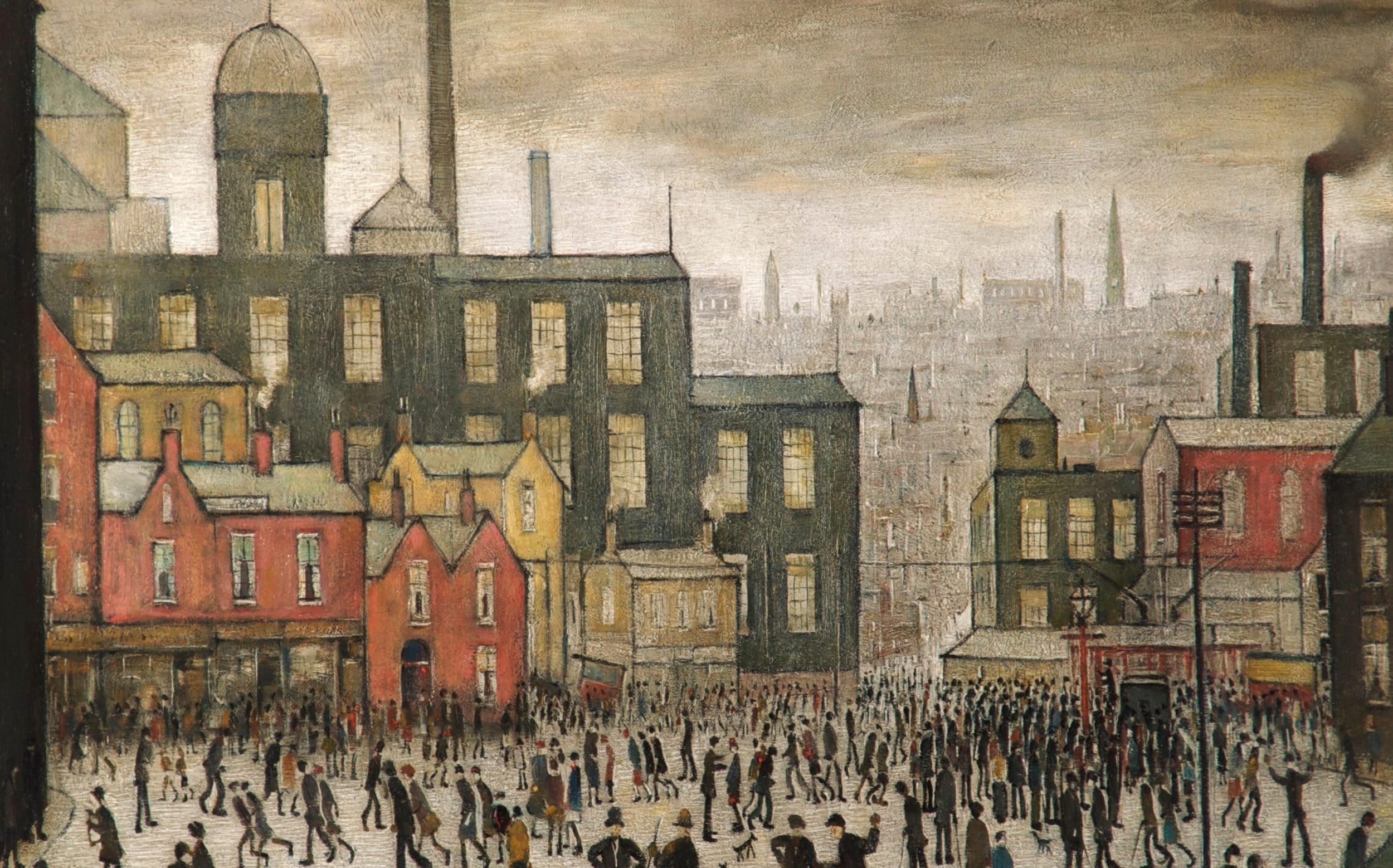
MK Gallery’s LS Lowry: The Theatre of Life provides a full account of the artist’s career (detail from Our Town, 1943) - Touchstones Rochdale, Rochdale Arts & Heritage Service
Is there a more misunderstood artist than LS Lowry, the subject of an absorbing, myth-busting new exhibition in Milton Keynes? For decades, this peculiar child of the Victorian era depicted northern England’s disappearing industrial landscapes. The way he did so earned him a reputation in some quarters as a Sunday painter: “a cloth-capped nincompoop” was the cruel verdict of critic Brian Sewell. Yet, according to MK Gallery’s LS Lowry: The Theatre of Life, half a century after his death, we’ve still got him all wrong.
Unlike Tate Britain’s 2013 Lowry exhibition, which concentrated on his composite industrial scenes, this show provides a full account of his career, from his earliest pencil studies and portraits of his parents, to his late, blank seascapes and a posthumously discovered cache of kinky drawings depicting a doll in constrictive clothing. At every turn, according to the gallery’s director, Anthony Spira, the exhibition challenges “misconceptions”.

The exhibition moves away from just showing his industrial scenes, including other works such as his blank seascapes (Seascape, 1952) - The Lowry Collection, Salford © The Lowry Collection, Salford

A Landmark, 1936 - The Lowry Collection, Salford © The Lowry Collection, Salford
Although Lowry mostly represented working-class people, he came from a middle-class family, and was employed for 42 years as a rent-collector. Despite his seemingly naïve style, he wasn’t self-taught; for a decade, he attended evening classes at the Manchester Municipal School of Art. One of his tutors was a French Impressionist, Adolphe Valette. Later, Lowry was a visiting lecturer at London’s Slade School of Art.
Eminently cultured (Lowry loved going to the Royal Opera House), he also collected art. Among the pictures in his clock-filled home were a crayon-and-chalk portrait by Lucian Freud and Dante Gabriel Rossetti’s 1877 oil painting Proserpine. Art-historical references in his own work – to, say, Pieter Bruegel the Elder’s teeming, antic tableaus – were surely deliberate. The Pond (1950), one of the large, panoramic showpieces characterised by ant-sized people scurrying around a toy-town cityscape that Lowry produced after the Second World War, reminds me, in its composition, of Diego Velázquez’s Philip IV Hunting Wild Boar in the National Gallery.
Advertisement
What’s more, while we tend to think that Lowry’s pictures present a near-monochromatic vision of working men subjugated by the capitalist machine (Monday Morning is the title of one painting from 1946), he often painted people of both sexes at leisure: in parks, at fairgrounds, on the beach, enjoying a Punch and Judy show, on their way to a football match. For years, his paintings delighted Marxists, but it isn’t all factory gates and smokestacks in this lifelong conservative’s pictures.

Lowry often painted people of both sexes at leisure (A Football Match, 1932) - The Estate of L.S. Lowry. All Rights Reserved, DACS 2026. Photograph courtesy Crane Kalman Gallery, London
Even the notion that Lowry painted “matchstick men” is misleading: his attenuated, caricature-like figures often have swollen, seemingly heavy lower limbs that terminate in oversized footwear like clown shoes. Humour is an under-recognised but important aspect of Lowry’s art. Moments of playfulness and wit lighten a nagging, prevailing sense of loneliness and alienation – despite his fondness for depicting crowds.

Lowry’s caricature-like figures often have swollen, seemingly heavy lower limbs with oversized footwear like clown shoes - The Lowry Collection, Salford © The Lowry Collection, Salford
Some of Lowry’s canvases are horrible: the subjects of several strained, unpleasant pictures resemble undead monkey-men, with zombie eyes and corpse-coloured flesh. Yet, as this clever, enterprising show reveals, Lowry was considerably more than a curious regional artist who perpetuated a stereotype of life up north as relentlessly grim.
MK Gallery, Milton Keynes (mkgallery.org) from Oct 24 until Feb 28
Source: “AOL Entertainment”
